

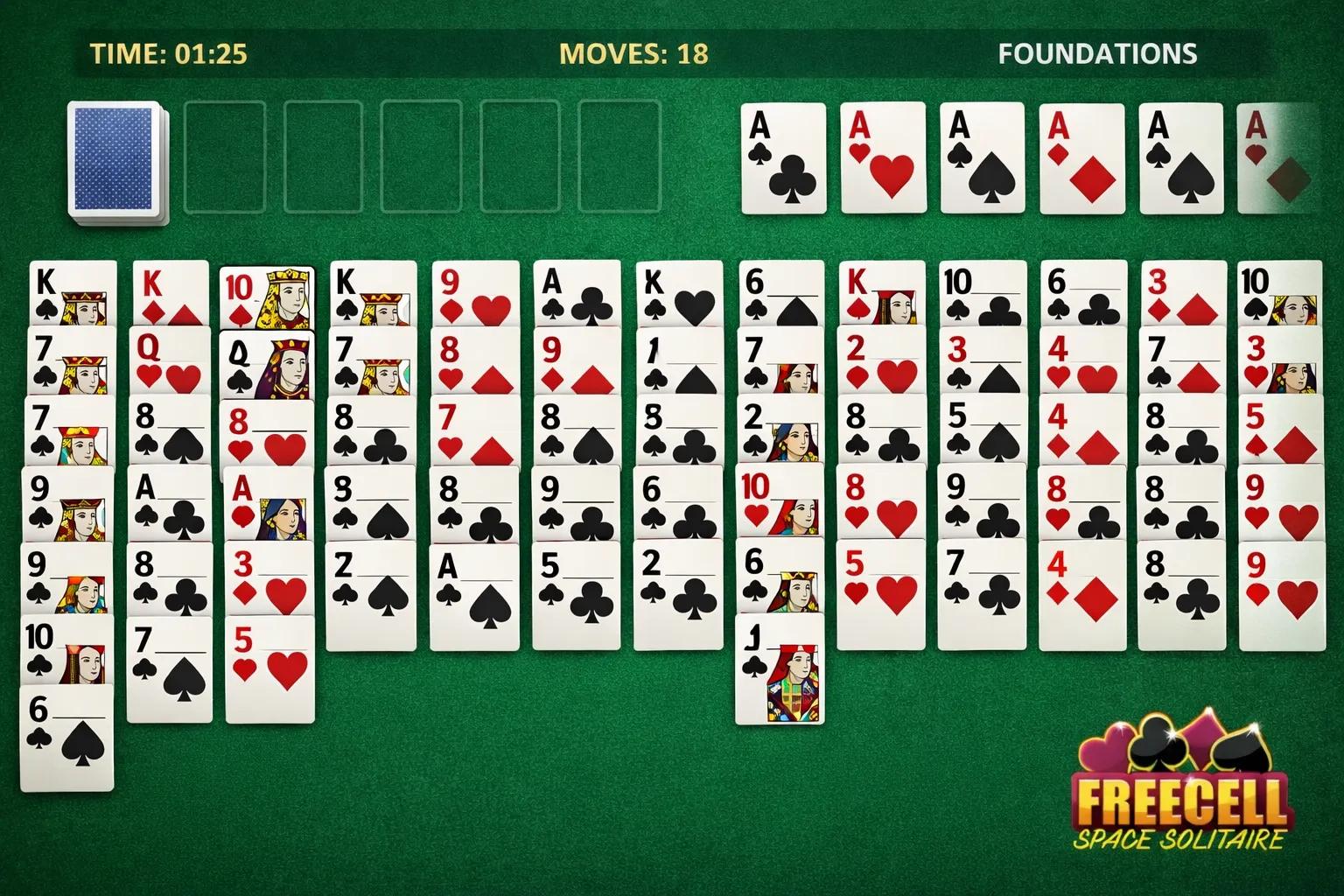
If you’ve ever opened a solitaire game and wondered why there are so many different versions of FreeCell, you’re not alone. At first glance, they all look similar—cards arranged in columns, four foundations at the top, and a few empty cells waiting to be used strategically. But once you dive deeper, you’ll realize there are several types of FreeCell, and each one offers a unique level of challenge and fun.
Whether you’re new to the game or someone who wants to explore beyond classic gameplay, this beginner’s guide will help you understand the most popular FreeCell variations and choose the right one for your skill level. If your goal is to play FreeCell online, this guide will also help you decide which version to start with.
What Is FreeCell?
FreeCell is a solitaire card game that became widely popular after being included in Microsoft Windows. Unlike many other solitaire games, FreeCell is primarily skill-based rather than luck-based. Nearly every deal in classic FreeCell is solvable if you play correctly.

The game uses:
A single 52-card deck (in the classic version)
8 tableau columns
4 free cells
4 foundation piles
The objective is simple: move all cards to the foundation piles in ascending order by suit. But how you get there depends heavily on the version you choose.
Why Are There Different Types of FreeCell?
As FreeCell grew in popularity, developers and card game enthusiasts created new versions to add variety and difficulty. These freecell variations modify:
The number of decks
The number of free cells
The building rules (by suit or by color)
The initial layout
This means not every version plays the same way. Some are beginner-friendly, while others are designed for advanced strategic players.
Types of FreeCell
1. Classic FreeCell – The Best Starting Point
If you’re new, always start here.
Classic FreeCell is the original and most balanced version. You build cards in descending order, alternating colors. For example, a red 7 can be placed on a black 8.
Why It’s Great for Beginners:
Almost every deal is winnable
Clear and simple rules
Teaches strong card management skills
Widely available when you Play FreeCell Online
Classic FreeCell is perfect if you want to understand the fundamentals before moving to more complex FreeCell Variations.
2. Double FreeCell – Twice the Cards, Twice the Strategy
Once you feel confident with the classic version, you might want more of a challenge. That’s where Double FreeCell comes in.

This version uses two decks instead of one. That means:
104 cards
More complex sequences
Longer gameplay sessions
Double FreeCell requires advanced planning. You can’t rely on simple moves anymore—you need to think multiple steps ahead.
3. Baker’s Game – A More Structured Challenge
Baker’s Game looks similar to FreeCell but has one major difference: you build sequences by suit, not alternating colors.

That means:
A red 7 can only go on a red 8 of the same suit
Strategy becomes more restrictive
Planning is much more critical
Because of this rule change, Baker’s Game is generally harder than Classic FreeCell.
4. Eight Off – More Free Cells, Different Layout
Eight Off is another interesting variation. Instead of four free cells, you get eight. Sounds easier, right?

While you have more temporary storage, the building rules are usually by suit, similar to Baker’s Game. The layout also differs slightly, changing how early moves unfold.
Best For:
Players who like flexibility
Those who enjoy experimenting with space management
Strategic thinkers
This version teaches you how powerful extra free cells can be when used wisely.
5. Multi-Deck FreeCell (3 or 4 Deck Versions)
Some platforms that let you Play FreeCell Online offer 3-deck or even 4-deck FreeCell. These versions dramatically increase complexity.

What changes?
More cards
Longer columns
Extended gameplay time
Higher difficulty level
This type of freecell is best suited for experienced players who want a serious challenge.
How to Choose the Right Type of FreeCell?
Now that you understand the main Types of FreeCell, here’s how to choose the right one:
1. Consider Your Skill Level
Beginner → Start with Classic FreeCell
Intermediate → Try Double FreeCell
Advanced → Explore Baker’s Game or multi-deck versions
2. Decide How Long You Want to Play
If you want:
A quick 5–10 minute session → Classic FreeCell
A longer, immersive game → Double or Multi-Deck FreeCell
3. Think About Strategy Preference
Do you prefer:
Flexible moves? → Classic FreeCell
Strict rules and planning? → Baker’s Game
Extra storage and space management? → Eight Off
Common Beginner Mistakes When Choosing a Version
Here are a few mistakes new players make:
❌ Jumping Directly to Hard Variations
Start simple before moving to advanced Types of FreeCell.
❌ Ignoring Free Cells
Free cells are powerful tools. Beginners often underuse them.
❌ Not Planning Ahead
Even in Classic FreeCell, random moves won’t work consistently.
❌ Sticking to Only One Version
Exploring FreeCell Variations builds stronger skills over time.
Final Thoughts: Start Simple, Then Level Up
Choosing the right Type of FreeCell isn’t complicated—it just depends on your experience level and what kind of challenge you’re looking for.
If you’re just beginning, start with Classic FreeCell. Once you feel confident, explore Double FreeCell or Baker’s Game. Eventually, try multi-deck versions for a serious mental challenge.
The beauty of FreeCell lies in its depth. What looks like a simple card game can turn into a highly strategic experience when you explore the different FreeCell Variations available today.
So don’t hesitate—experiment, practice, and most importantly, enjoy the process as you play freecell.